


As I write the more than 3,000 pineapples planted in Education Orchards One and Two are beginning to fruit. It is year three and by 2023 it is estimated that the net income from the orchards can be conservatively projected at $50,000 a year. The original intent was to use this money to pay for school fees, uniforms and school supplies, but now that newly-elected Sierra Leone President Julius Maad Bio has announced that secondary school fees will be paid by the government this opens the possibility of multi-faceted support for education that may include the hiring of additional teachers, improving school facilities and college scholarships.

This is the story of Paramount Chief Charles Caulker, a visionary man who believes in the transformative power of education as Bumpeh Chiefdom recovers from a brutal civil war that ended in 2002 only to grapple with the Ebola crisis. He does not want to be reliant on outside support either from the Sierra Leone government or from NGOs. Towards this end he brought together teachers in his community to form the Center for Community Empowerment and Transformation (CCET) that now–more than five years later–is implementing a vision for the future. It is led by Rosaline Kaimbay, a strong-willed and highly competent educator. She has pulled together a formidable team that includes Timbo Sulaiman who manages the accounting for CCET and oversees a small business that offers photocopying and printing (with a printer purchased with a District 6380 grant in 2016) that generates income for CCET. Teacher training and an intensive tutorial program for students preparing for their secondary school exams is the responsibility of Haruna Gebril. Kalilu Sannoh provides oversight for orchard laborers and, most recently, Ibrahim Rogers has been hired as the Agriculture Manager.
It is also the story of Arlene Golembiewski who started Sherbro Foundation with the express goal of supporting the vision of Chief Caulker and the work of CCET. More than 30 years ago she was a Peace Corps volunteer and taught with then Charles Caulker. When she returned following a career with Proctor and Gamble she decided to fully commit to help the Chief realize his vision. Towards this end, the Rotary Club of Ann Arbor and District 6380 have taken the lead in securing additional support, first for a District Grant, then a Global Grant and we are now awaiting approval of a second Global Grant fromRotary International that will provide the money needed to complete three Education Orchards; and a Hospital Orchard for the creation of a Benevolent Fund to pay for patient care. (The Wilmington NC Rotary Club has raised the funding and is providing oversight for this aspect of the project.)
And finally it is the story of the Freetown Rotary Club, and specifically Theodora Wilkinson (center) who as an educator in her own right is vested in the project and has made numerous trips to the Chiefdom to provide oversight. Pictured to the left is Lara Taylor Pearce, the Club President and on the right yours truly.

There are many facets to our involvement with CCET, but mostly I am going to focus on the orchards and other agricultural initiatives.

As part of the first Global Grant 26.4 acres have been cleared and planted. The trees, now in their third year, are beginning to fruit. CCET has entered into an agreement with the family that has rights to the land to lease it during 2019 and then begin making payments for its purchase over a three year period, assuring that CCET will have rights to the orchard land in perpetuity. Assuming the second Global Grant is approved by Rotary International a similar agreement has been discussed with the family that has rights to additional acreage that will be used for the third Education Orchard and the Hospital Orchard. In the interim the family has agreed to a 50-year lease.
Seedlings also continue to be given to families of newborns when births are registered. In the bottom left photo, Rosaline Kaimbay is standing next to a young tree that has been planted contiguous to a family’s home. Registration makes children eligible for government services and was a focus of the first Global Grant. Families are also taught the importance of saving for education.

Perhaps one of the most illuminating things that we did–at the urging of Mr. Rogers–was to visit another farm in Ribbi Chiefdom that is on family land owned by Kenneth Mahoi. He spent a number of years working in the United States, saved his money and cashed in a 401(K) in order to develop land his family has rights to in the Chiefdom. Mr. Rogers worked with him for a number of years and Kenneth attributes much of his success to advice he received from him and, in particular, the use of a swampy area to create naturally irrigated berms for planting vegetables during the dry season.
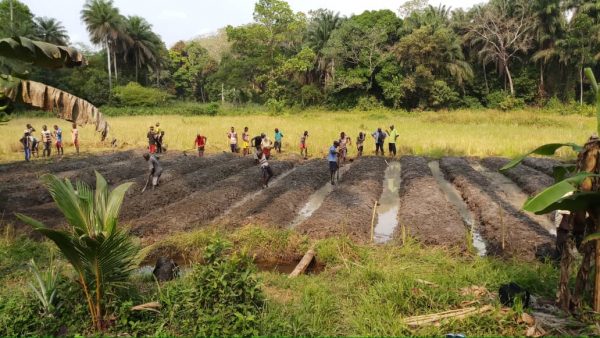

Mr. Mahoi said that his success was attributed to the planting of vegetables during the dry season in the swampy area of his property. The selection of crops to plant is based on market pricing. By the next day Mr. Mahoi had traveled to Bumpeh Chiefdom to see the CCET Orchards. The new land to be developed includes a swampy area and Mr. Rogers immediately hired 30 laborers from a nearby village, including some of Mr. Mahoi’s experienced swamp builders. Below is work in progress. You can see the way that the rows are being naturally irrigated. Most onions are imported so they anticipate that there will be a good market for the harvest. Women are traditionally the vegetable farmers so they will be hired to do the planting.

The goal here is to develop 5 acres and to plant not only onions, but peppers and sweet potatoes as well. A berm will be built around the field to hold in water during the dry season. A shallow well is also planned to hold even more water for irrigation during the months of March and April before the rains begin. By doing this, fast income will be generated that can be used for orchard development.
So, this is just a bit about this extraordinary project. I have just skimmed the surface here of what was a remarkable week that included a boat trip to some of the smaller villages; dance performances by the Bundu and Poro Societies, a visit and speeches at one of the schools. Slowly Rotifunk is recovering. Originally a village of 10,000 during the Civil War everything was destroyed with the exception of churches and mosques. The Civil War ended in 2008. Burned out buildings are everywhere. The village now has a population of 8,000 and is slowly recovering.
Above all, there is incredible gratitude expressed to Rotary International and District 6380 from Rosaline Kaimbay and Paramount Chief Charles Caulker and all of the beneficiaries in Bumpeh Chiefdom. I was so humbled by our visit and the opportunity to see first-hand the work that is being done.

Special Thanks to the Staff of Rotary International
Bonaventure Fandohan, Area of Focus Manager for Economic & Community Development, made a personal visit to Rotifunk and saw first- hand the power and passion of the women involved in the Vegetable Growing Project and was able to meet and talk with the CCET Staff. David Masseywho is the country contact for Sierra Leone has walked me through the application process sharing insights and recommendations along the way. His on-going support is deeply appreciated.
…And to Members of the Ann Arbor Rotary Club.
Paul Smith, Chair of International Humanitarian Projects has been unwavering in his encouragement and support; Ashish Sarkar has always been ready to provide wise counsel and steadfast belief in projects like this.
Project Update
After returning, I wrote a report for the District Global Grants Committee and was heartened by the response, a willingness to increase the District’s level of support. The Rotary Club of Mount Clemens also offered additional support. With the blessing of Rotary International, we have been able to adjust the budget prior to final approval and the Women’s Vegetable Growing Project will now be funded once the Global Grant is approved. This will move 174 women from subsistence to self reliance and a secure income.
Cheryl Farmer, Treasurer of Sherbro Foundation and member of the Ypsilanti Rotary Club and I have worked together on this project and we are deeply grateful to all of the Clubs and individuals that have provided support. Thank you.
By Mary Avrakotos, Rotary Club of Ann Arbor


