


President Mark Welcomes a gathering of nearly 60 Rotarians in the Anderson Room at the Union on a humid and sunny afternoon. Resident Pianist Tom Strode gathers us in joyous song as we sing God Bless America during our patriotic opening of the meeting.
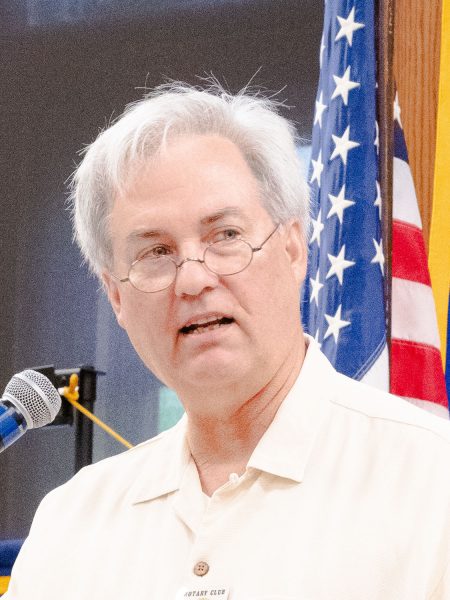
New member Dennis Burke shares an inspirational story to help his fellow Rotarians reflect on our self-narratives and abilities. He told a story about a child wandering off to the wonders of childhood in lieu of doing the chores asked by his parents. The story unfolds as we expect, with the wisdom of elders challenging the child’s perception of what is possible. Using the phrase “I can’t” hinders all of us in learning a new skill; both children and adults can expand abilities by asking each other for help–we called and answered with “Dennis, there is no such word as “Can’t” in the English language” to reframe what is possible when we work together on a common goal.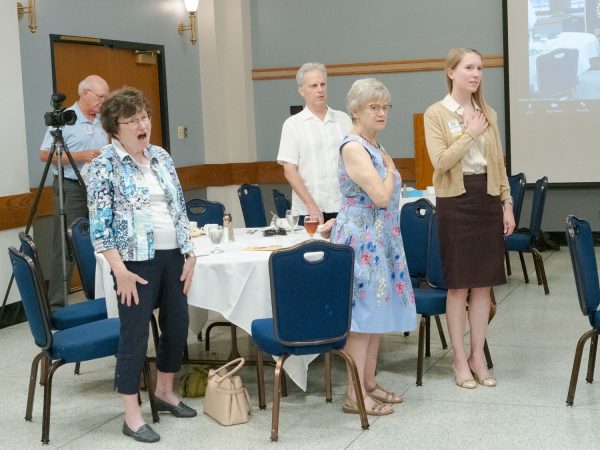
President Mark Foster welcomed guests who were introduced and the RCAA membership welcomed all the visitors with a round of applause.
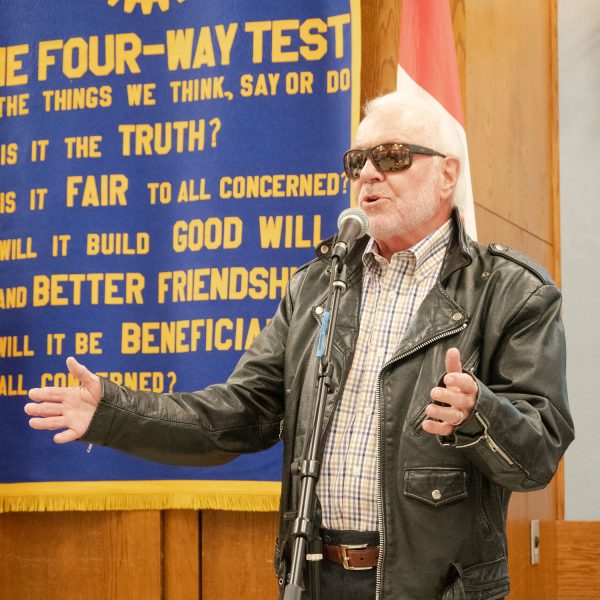
Joe Diederich along with his side kick, Curt Waugh gifted the club with a do-wop song to lift spirits and envelope us all in diversion with his light-hearted nostalgic ditty! Don & Juan, along with the Dip Sticks and Dip Chicks, came to light us up! The Fonzie jacket came out, and club members became the back up singers! With Joe at the helm, shouting encouragement to harmonize our ditty, the club erupted in a foot-tapping sing-a-long!
President Mark gave our deep and sincere thank you’s to the following club members for making our meeting run smoothly this week: Dawn Johnson, Sarah Maddock & Leo Shedden, U of M Union Representative & Debra Gerber, Rob Shiff, Tom Millard, Dennis Burke, Leo Shedden & Yolanda Whiten on Zoom, Kate Van Horn, Fred Beutler. He went on to announce birthday wishes to several members and we cheered.
President Mark regaled us with several medical jokes with Ohio State at the butt, followed by Greg S. sharing that plenty of opportunities to volunteer still exist for our big Annual Charity Golf & Pickleball Outing. He noted that club members interested in signing up after the meeting could visit Kate at the welcome table after the meeting to register today.
Kathy Waugh gave a fabulous announcement about our silent auction and encouraged all club members to SHARE!! emails with friends. Many fabulous auction items have already been donated! Lori’s famous bourbon basket, Ken Fisher’s suite at Comerica Park, an all-inclusive 5-day trip to Maui, and more! This event is not to be missed, so be sure to get your tickets and help support this important cause to “Create Hope in the World.”
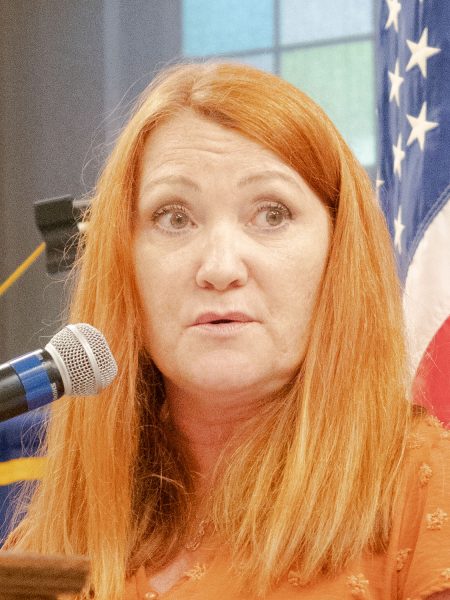
The golden pipes of our very own Ann Arbor Rotarian Streve Schram gave us a thorough news update: in Michigan football news, Harbaugh will likely be suspended for the first 4 games of the seasons. Fast chargers are going to be installed by the government in order to encourage consumers to purchase electric vehicles. $7.5 million dollars has been awarded to the University of Michigan for nuclear power research from the Department of Energy. In weather, it’s breezy & humid with thunderstorms this evening. Steve signed off with “That’s all for this week’s Rotary News Now!”
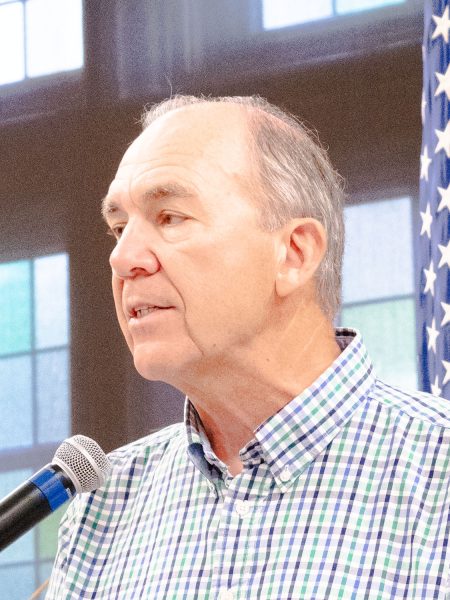
Next up, club member Rob Schiff came to the podium to inform membership about results of the hybrid meeting survey results. He shares that unfortunately, there is not one clear answer from the survey, however, we did have great participation. Financially, the board and club leadership has managed to keep a strong financial position by reducing expenses in an ongoing way. The budget is currently balanced (for the first time in a long time) and there are no other savings to consider. Several options including moving locations, using different techniques, and rentals to the Union A/V team are also under review to consider alternative options. Current membership level will require additional funds to continue the hybrid meeting after October 1st. A copy of the results from the survey will go out in the next Ann Arbor Rotarian newsletter.
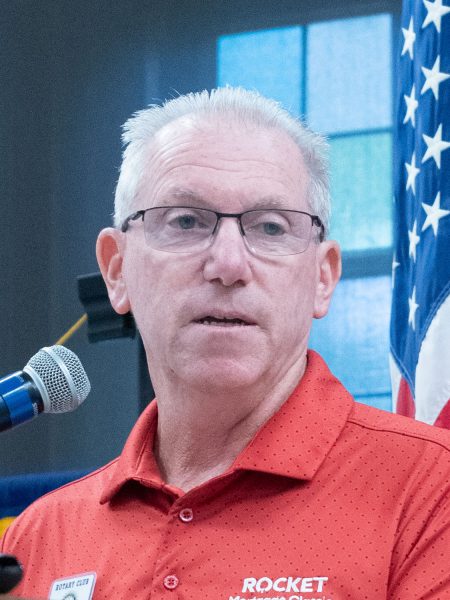
President Mark shared that we will now be sharing meeting duties by assignment with details in a recent email. We will be going back to this model in August and it will be each club member’s duty to find a substitute. We will look into an analog posting option as currently the only way to see your assignments is via online spreadsheet.
Club Member Dennis Powers came to the podium to introduce us to today’s speaker, retired biology professor, Knute Nadelhoffer. Dennis called upon us to turn our minds to memories of the American mid 20th century: quickly flashing us to World War II and The Vietnam War. He reminds us this was a defining moment in American history with strong civil division, polarization, and global fear. Yet the Korean War has much less hold on our collective memory. Despite the lack pf public memory, families of the honorable veterans who fought have not forgotten the great duty and service of their elders. Knute lost his father in 1953 to the Korean War, near the division line between north and south Korea. Knute will share today his story of his recent visit to Korea and how he is making peace with his personal, and our national, collective, loss from the Korean War.
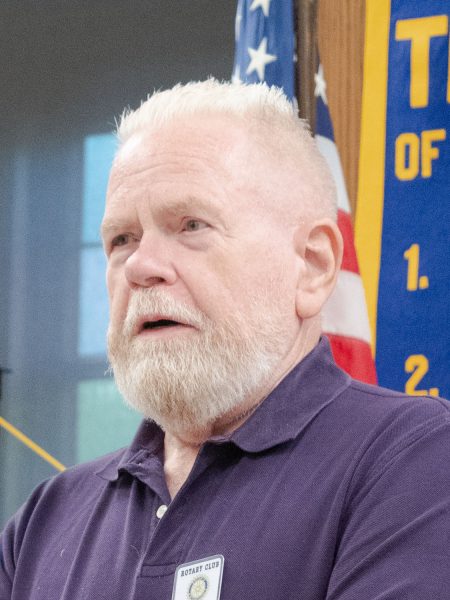
Knute came to the podium, pointed at our Rotary 4 Way Test Banner, and agreed that these are wonderful life guideposts. It is true the Korean war is a never ending conflict, tomorrow marks the 70 year anniversary of Armistice Day that marked the withdrawal of American troops. Despite the Korean “Conflict” being downplayed by US government officials, it was indeed a war, and we are still in it. We are at risk of nuclear war, and there is still danger in the 70 year stalemate.
Knute posits that it is our obligation as the most powerful country in the world to provide diplomacy. He goes on to share that in his view, the only alternative to diplomacy is war.
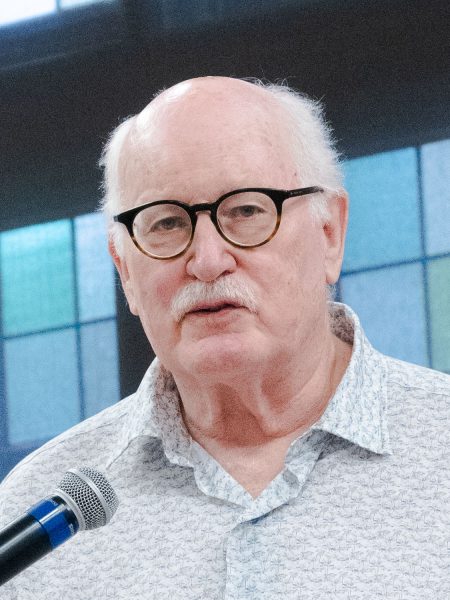
Last year, Knute was able to participate in a trip to Korea for gold star families. He shares a bit about modern Korea: it is about the size of Michigan’s lower peninsula, with a population of 52 million. 80% of the country is urban and is the 12th largest economy in the world. There are sixteen Fortune 500 companies in Korea. It’s modern, and mountainous, and densely populated with high activity. He learned that during the most active years of conflict, civilians were the largest casualties, far more than lost soldiers.
Knute helps us place his father and his personal life story alongside the recounting of historical details: on June 25th, 1950, the Korean conflict became “official” as a military police activity. On June 30, 1950, Knute was born, and on the same day, the US proclaimed the conflict and called troops to deploy to Korea. Knute’s father was a naval aviator and a US Marine who had served in World War Two. The Korean War was called the forgotten war, “the war between the wars.” Knute is a biologist by training, but feels like an amateur historian with his interest in the Korean War.
He goes on to share the story of Jesse Brown, graduate of Ohio State, who was a fighter pilot and naval aviation, and he decided he would serve, in spite of being a child of sharecroppers and African American. He encountered enormous racism in the Navel training program but against all odds, he made an unlikely friendship with a wealthy white man, going on to became each others’ wingmen in action, and they maintained a long and deep friendship. They flew coarse air fighter planes. Jesse’s plane was shot down, just exactly the same thing that happened to Knute’s dad’s plane. Jesse froze to death after his crash landing. Wingman Hundner wasn’t able to rescue Jesse, but he was able to save the design of the plane from the North Koreans stealing the design. This was outside of the Chosen Reservoir, one of the most horrific losses US & UN troops experienced.
Coming home to the states, it was relegated to the backs of minds with returning veterans. Especially the Korean war, there was collective denial in the civilian world. Picasso’s 1951 painting, Massacre in Korea, depicts a sliver of the evil atrocities. Knute went on to share more historical details about the leaders of both North & South Korea, giving a small example of many series of failures in leadership, resulting in the loss of hundreds of thousands of lives. A thoughtless remark made by Secretary of State, Dean Achenson, gave an easy entry point for Russia to support North Korea in unification, and ergo a tacit green light to violently invade South Korea in 1950. President Truman gave permission to US Generals to deploy troops without congressional approval, leading to a three year bloodbath. The DMZ is near the 38th Parallel where Knute’s dad was lost in battle with honor in early 1952. Knute is capturing the memories of his father’s legacy in the Library of Congress. Knute ended today’s personal recounting of our global memory with an urge for all to support bipartisan House Resolution 1369 by Brad Sherman for peace in Korea.
President Mark Foster gave us a quote from the great TV program, M*A*S*H, set during the Korean War, “The men were drafted, the women volunteered.” He rang a solemn bell to dismiss the meeting.
Submitted by Kate VanHorn

