


With a chilling wind scurrying us into the warm Anderson Room of the Michigan Union, President Joyce welcomed us to join pianist Jody Tull de Salis in the singing of America the Beautiful. Michelle Deatrick inspired us with the news that today is International Human Rights Day and read a moving poem by W. H. Auden, Refuge Blues – as timely today as when it was written in 1939.
Song leader Don Devine, celebrating the 78th Wednesday he has led us in turn-of-the-20th century popular songs, led us in the singing of the 1912 hit, When Irish Eyes are Smiling, then channeling our inner Vera Lynn, we sang the poignant 1939 war song, We’ll Meet Again.
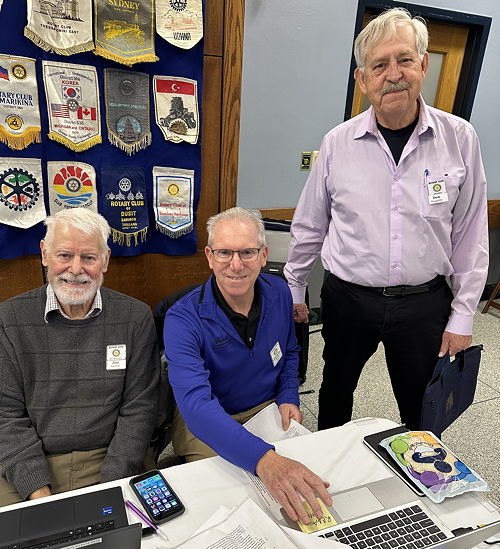
President Joyce thanked today’s meeting team including Rob Schiff, Jim Egerdal, Don Duquette, Leo Shedden, Bob Harrington, Dennis Powers, Dennis Burke, Mark Foster, Mary Steffek Blaske and Glenna Miller. The club cheered for this week’s four birthday celebrants.
President Joyce reminded us that our all-important CSA dues of $200 are due now.
Dennis Powers gave us a review of the semester with our Rotaractors. He highlighted activities in including:
- domestic service – an upcoming work trip to the western US to help maintain and build hiking trails;
- environmental – water bottle and paper towel challenges;
- professional development – we have 21 mentor-mentee matches within our club.
- The Rotaractors enjoyed a special talk presented by Sierra Sutherland of the UM’s Career Center on Resume writing;
- Social – 205 volunteer hours worked over 8 projects including their favorites with our club: Send Hunger Packing and the Highway Pick Up.
Powers noted that 12 Rotaractors and 25 Rotarians met at Knight’s on Dec. 2 for the Charter Dinner which celebrates the chartering of this Rotaractor club on the UM campus. A shout out to Knight’s on Liberty which donated the space and the kitchen and wait staff, and opened up on an otherwise closed-to-the-public evening.
Norman Herbert updated the Club on the state of the Ann Arbor Rotary Foundation, a separate 501 (c)(3) entity of our club that allows tax-deductible gifts which help generate funds over and above what is provided through the CSA dues. (See above that our CSA dues are due!) The value of the fund as of Sept. 30 is over $3M. Please also see the foundation’s web page and the web page explaining the foundation’s investment policy.
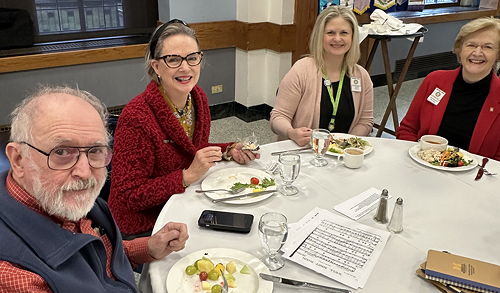
Housing costs are a burden for many seniors in Washtenaw County
John Juroe introduced today’s speaker Yvonne Cudney, Outreach and Community Coordinator for the Michigan Medicine’s Housing Bureau, who spoke about older adult poverty and housing in Washtenaw County.
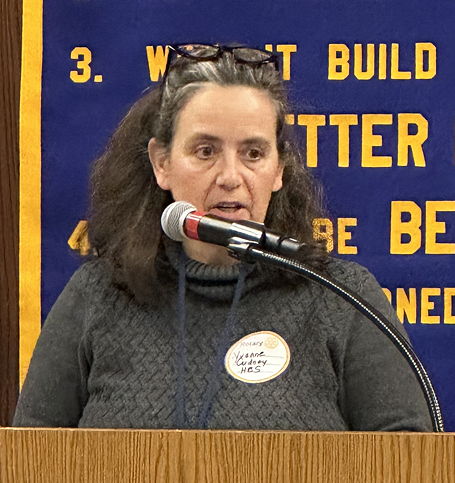
One of the 13 bridge-building programs between the University of Michigan Health and the community is the Housing Bureau for Seniors (HBS). The Mission of the Housing Bureau is the recognition that stable housing is imperative to physical and mental well being, and to that end the Housing Bureau for Seniors (HBS) informs and empowers older adults and those who care about them by providing guidance and resources regarding sustainable housing in Washtenaw county and beyond. One does not need to be a patient in the UM health care system to take part in these free programs. Three of the HBS’s core programming include:
- eviction prevention;
- housing counseling; and
- foreclosure prevention.
Cudney noted that by 2028 people over 65 will outnumber those 18 or under. Currently 20% of people in Washtenaw County are older adults. She detailed that of residents 65 and older, 82% own their own home while 18% rent. The hosing cost burden to the home averages 26% of their monthly income while the home renter is 53% of their monthly income.
The most common source of income for older households is Social Security which constitutes a third of the income reported by households age 65+. In Michigan, the average Social Security payment for older folks is $1,657. The median income for householders 65+ was $50,000. In Michigan the average income of older adults is $46,380.
Cudney shared the sobering figures that the annual federal poverty level for a single person is $15,060 (or $1,225 per month). In Washtenaw County 13% of households have incomes below the poverty level. The annual ALICE (Asset Limited Income Constrained Employed) level for a single older adult in Washtenaw County is $39,900 (or $3,325 per month). She broke down the austere $39,000 ALICE budget by month:
- Rent: $884/month
- Housing/Utlities: $163
- Food: $460
- Transportation: $398 (assumes this is a car in good repair)
- Health Care: $553
- Technology: $86 (assumes you already own a phone and computer)
- Misc: $254
- Tax payment: $527
- Monthly Total: $3,325;
- Annual Total: $39,000
The average rent for an 889 sq-ft. apartment in Ann Arbor is $2,089 and in Ypsi it is $1,509 – already over and above the ALICE parameters.
Cudney clarified the difference between subsidized and affordable housing: subsidized housing is where one pays 30% of their income for rent. It is a federally funded program and to qualify one must have income below 50% of the area median income and get their name on a wait list that is often years long. Affordable housing also requires income at or below the area median income and offers units below the market rental rate. In fact, rent is capped at 1/3 of the fair market rent (but because people who qualify often don’t earn quite that much – the rent is often more than 1/3 of their income). But it is still less than market rate.
Washtenaw County has a total of 1,856 affordable and subsidized senior units – two units of affordable housing for every 10 older adult households that are housing-cost burdened. Cudney showed us an example using the food industry worker who works at $14.49/hour for 40 hr/week for 50 weeks, results in an annual income of $29,000. This would qualify that worker to move into a 60% unit and spend over half his or her gross income on housing.
Across the country, about 138,000 older adults aged 55 and over experienced homelessness on a single night in 2023. This represents about 21% of the total number of people experiencing homelessness. Of these about 6% were aged 65 and older. Some of these unhoused individuals are chronically homeless, but a growing number of them became homeless for the first time. Circumstances that cause older adults to lose their housing include a change in income or family composition brought on by sickness, divorce, or the death or illness of a partner or change in need precipitated by a health crisis or new disability.
Cudney concluded by saying that there were a number of ways to help older adults to live safely in a stable place with dignity:
- be aware that they exist and need help;
- offer financial assistance to HBS or other organizations that assist older adults;
- volunteer with moving belongings, assisting with lawn or household chores or volunteer with Meals on Wheels in Ann Arbor or Ypsi.
The meeting concluded with President Joyce asking us to stand and recite the 4-way test:
- Is it the TRUTH?
- 2. Is it FAIR to all concerned?
- 3. Will it build GOODWILL and BETTER FRIENDSHIPS?
- 4. Will it be BENEFICIAL to all concerned?

