


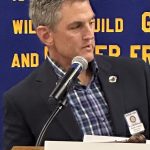
Three distinct-sounding sighs were heard while coming to today’s meeting. The first – the sigh of students stuffing their dorm belongings into the family car – already wistful for their time so quickly passed as a student. The second – a parent’s sigh who, while happily anticipating their child being home for the summer, is wondering if the serenity achieved during the academic year will ever return with their youngster back home? And the third sigh – from all the Rotarians circling ’round and ’round the block trying to find a parking place without an orange meter hood designating “dorm move out only” parking.
President Mark rang the bell to start the meeting and our dapper, bow-tied pianist Tom Strode played our National Anthem. Joe Diederich stepped up to the podium and traced out the tremendous span of world events – from a polio cure to high speed internet – within our lifetimes. Cheers to all who came of age during the 60s through 90s who have done a tremendous job of adapting to change.
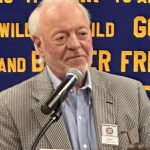
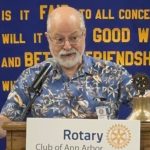
Dave Keosaian brought the tender sounds of 1911 with Love’s Old Sweet Song to life, accompanied by pianist extraordinaire Strode.
President Mark resumed the podium to thank today’s meeting team: Linda Kentes, Leo Shedden, Ed Johnson, Dennis Burke, Kathy Waugh, Don Duquette, Sara Maddock, Ben Bolen, Tom Millard, Mary Steffek Blaske, and Ugur Cetin. Guests and visiting Rotarians were introduced and welcomed. Foster announced this week’s birthday celebrations and with a great fanfare announced Dallas Dort’s 55th and Tom Kauper’s 45th anniversaries of Rotary service.
Reaching deep into the humor vault President Mark shared today’s puns including “What do you get when you milk a pampered cow? Spoiled milk,” and “what coffee was served on the Titanic? Sanka.”
Barbara Eichmuller introduced David Auer as our newest Club Member. Auer has enjoyed a successful career in computers and business and is looking forward to serving on our Club’s VITA and GPO. Welcome, Dave!
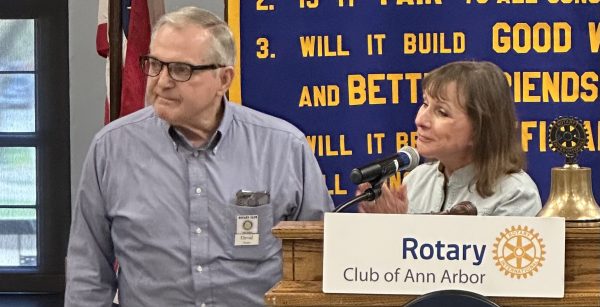
Sam Kottamasu came to the podium to remind our Club of the upcoming Yoga Retreat on August 17-18. Early bird registration runs to July 3. Scholarships are available for medical students. Contact Sam for sponsorship opportunities.
Filling in for Todd Kephart, Greg Stejskal reported that the 20th Rotary Fights Hunger campaign was a success. Approximately 80,000 meals were provided through cash gifts of $32,000 and 6,000 pounds of food. Committee members Steve Kesler, Todd Kephart, Norman Herbert, and Greg Stejskal were acknowledged for their spearheading the campaign.
Downs Herold introduced today’s speaker, Paul Erickson, the Director of the Clements Library.
A Minnesota native, Erickson received his B.A. from the University of Chicago, and his M.A. and Ph.D. in American Studies from the University of Texas at Austin. His pedigree showed when he shared that at the upcoming UM v UT football game this fall, he will be wearing orange. He served as Director of Academic Programs at the American Antiquarian Society, a research library of early American history and culture located in Worcester, MA. He then became Program Director for Humanities, Arts & Culture and American Institutions, Society & the Public Good at the American Academy of Arts & Sciences in Cambridge, MA. He began his Clements Library directorship in 2020. His goals as Director are twofold: 1) to strengthen the collection of print and manuscript materials on the history of North America and the Caribbean, with particular strengths in 18th and 19th century American history; and 2) to let the public know what the Clements is.
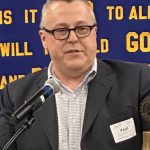
Erickson gave an overview of the Clements Library, founded through the collections of UM’s first engineering grad, William Clements. (Clements produced the steam shovels that helped to dig the Panama Canal.) Architect Albert Kahn designed the Library and the Library opened in 1923.
One of Erickson’s most memorable classes as an undergrad was “Human Being and Citizenship.” It challenged him to find the connections among being human with all our goodness and flaws and how those essences of humanity tie in with being a citizen. Erickson noted that humanities study not only how to live in harmony but also examines what tools we need when humans do not work in harmony.
He cited a recent survey of 5,000 people who overwhelmingly (as much as 91%) supported humanities, took part in some aspect of humanities, who wished they had taken more humanities when in school, and wished they had studied more history while in school. Yet 51% thought “humanities” as an elitist concept. Clearly, Erickson stated, “a problem of branding.”
Erickson asked what is the crisis in the humanities? With the slashing of humanities departments in centers of higher education and fewer jobs in the humanities, there are fewer students choosing the humanities career path. Given the high cost of higher education, the return on investment isn’t good. However, he notes that without qualified and knowledgeable high school history teachers for example, there will be generations of youngsters who never know their history, nor have the tools to think critically.
Crisis of recognition
Erickson noted that funding for the humanities is thin. The National Endowment for the Humanities is poorly funded, perhaps in part because of the difficulty in today’s quantitative mind set to address the concept of how to grasp human things in human terms. In a world where “research” looks like STEM with highly technical equipment, what does humanities research look like?
Erickson closed by stating that close reading of historical texts is critically important. It is not easy because there is much context and layers of fact and nuance to put together in order to study and make sense of what you see. The Clements Library is important because it is a laboratory of humanities research. Research is not solitary, and the professional network of historians, librarians and archivists at the Clements make that research possible.
Erickson invited questions and then invited Rotarians to walk down the street to visit the Clements. The Library is open and welcoming to the public. By making an appointment ahead of time, the skilled people who work at the Clements can start to amass the materials you wish to investigate before you arrive.
The Club gave Erickson a warm round of applause.
President Mark closed the meeting by asking all to rise and recite the four-way test:
1. Is it the TRUTH?
2. Is it FAIR to all concerned?
3. Will it build GOODWILL and BETTER FRIENDSHIPS?
4. Will it be BENEFICIAL to all concerned?
Respectfully submitted,
Mary Steffek Blaske
Reporter

