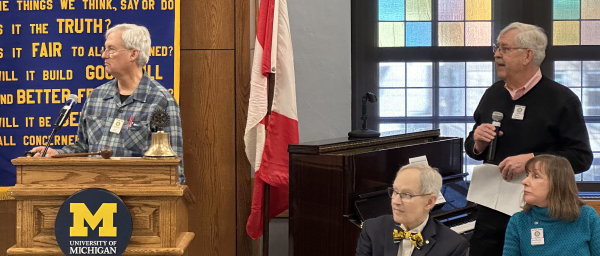
The Union’s Anderson Room was abuzz with lively conversation and laughter, warming up a particularly freezy breezy day. President Mark called the meeting to order and pianist extraordinaire, Tom Strode, accompanied the club as we sang our National Anthem. Sarah Strader then gave us a most-inspiring welcome. With infant Jamie (sporting a natty Lion King cap) held in her arms, Sarah shared with us “wisdom from children,” gained from her international teaching career of educating little ones. “Spend lots of time with the people you love the most.” “Keep confetti in your pocket so you are ready to celebrate when something great happens!” “Do one thing at a time and do it well, instead of doing multiple things at once and doing them poorly.” She provided each table with a dozen of these sayings and invited us to choose one that spoke to us. She then invited us to put that inspiration in our pocket as inspiration that we can keep with us for 2024 … or to use as confetti.
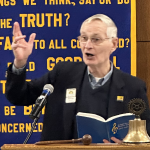
Downs Herold led the club in Smile and the World Smiles with You, and then in a rousing chorus of The Victors. (The Victors in preparation for UM Marching Band Director John Pasquale coming to speak to us on Jan. 31.)
Downs Herold
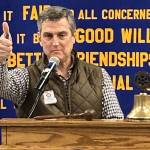
President Mark came back to the podium and thanked today’s entire set up and production team: Linda Kentes, Jim Egerdal, Rob Shiff, Sara Maddock, Bob Mull, Dennis Burke, Carolyn Hiatt Barbara Eichmuller, Mary Avrakotos, Mary Steffek Blaske, and Ugur Cetin. Ralph Katz then gave a shout out to the birthdays being celebrated this week as well as the one-year anniversaries of Shirlee Kipp, Susan Shipman, and Wendy Zielen.
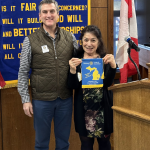
President Foster & Emma Timms
Four distinguished guests were introduced and one, Emma Timms who has been visiting with us for a month, came to the podium to receive an Ann Arbor Rotary Club banner to take back to her UK club. She expressed her enthusiasm for being at our club’s interesting and friendly meetings.
President Mark shared his cold-weather puns to the groans and chuckles of everyone.
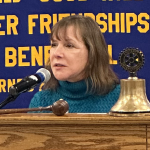
Barbara Eichmueller came to the podium to remind members of the terrific tool: ClubRunner. For our members unsure of how to install or use this tool, John White will be available at the next meeting to help you set it up. Bring your phone and lap top for him to help you. Membership is a great committee and would welcome your presence: 2nd Tuesdays from 5:15-6:15 p.m.
Barbara Eichmuller
Dennis Burke and Don Duquette representing the Environmental Action Committee gave us a pop quiz, the results pointing out that if we have questions about something being recyclable: 1.) Don’t recycle questionable plastics inside a black plastic bag; 2.) Don’t put any questionable recyclable material in the recycle bin; 3.) The use of single-use plastics are unfortunately growing – try to use something that can be reused; and 4.) Oil and gas companies are looking at plastics to support their industries as fossil fuel use declines. Winners of the quiz received eco-friendly reusable paper towels. Also remember to bring single-use plastic bags, batteries and printer cartridges to Rotary meetings to be recycled properly – watch for the receptacle bins by our meeting greeters.
Bob Mull, driving energy behind the VITA (Volunteer Income Tax Assistance) program, shared with us that this year the team of excellent Rotary volunteers (Robert Mull, Ben Bolen, Bob Buchanan, Dave Williams, Eric Macke, Dennis Burke, Fred Beutler, Ed Johnson, John Chamberlin (Marsha’s husband), Margaret Needham (Rotaract), John Sepp, Kate VanHorn, Karen Gladney (now Highway M36 Rotary member), and (hopefully) Tom Millard) hope to process 1,200 returns! This will be up from 670 returns processed last tax season. This year, Mull explains, the VITA volunteers will have some challenges to the Michigan returns because of changes regarding retirement income taxation based on age. Live clinics begin Jan. 29 and run through the April 15 tax deadline. A subset of volunteers will continue into summer to process late filers and prior year returns.
Bob Mull
Downs Herold introduced our own club member Alexis Antracoli, who is the Director of the Bentley Library. Antracoli’s talk proved that “Archives are for Everyone.” She began by defining an archive as an Organizations that collects records of enduring value; assesses and appraises documents; organizes/arranges and describes documents; preserves digital, video, audio and paper documentation; and provides access to those documents through on-site as well as virtual research.
Alexis Antracoli
While many people imagine an Archive as stodgy, Antracoli emphasizes that the Bentley is welcoming and encourages people to come and experience its variety of collections. Examples of being welcoming are flexible weekday and weekend hours (not simply M-F 9-5); outreach to students and the public in general; community partnerships (not just with scholars); and marketing and social media to connect to the public.
The Bentley was founded in 1935 as the Michigan Historical Collections and currently has more than 11,000 different types of collections. It boasts free parking and a welcoming knowledgeable staff. One of its collections is our own Rotary Club’s records. You’ll also discover important items such as a civil war diary from 1863 scarred by a bullet hole (the diary no doubt saved his life by absorbing the bullet), UM’s women’s basketball team from 1910, and the 1820-1840 papers of an early abolitionist doctor. The Frankel Observatory is also affiliated with the Bentley.
The Bentley has a strong public programming component including Making Michigan (virtual tours including with the Observatory across from the UM hospital), U-M Walking Tours (general, the law quad and even area cemeteries), Osher Lifelong Learning Institute Programs (OLLIE), Astronomy Night at the Frankel Observatory, Art and Archives Workshop (making collages based on inspiration from documents at the Bentley).
Because of the UM’s especially powerful mission/education focus in the early 1900s, the Bentley is the recipient of an extraordinary abundance of materials on the Philippines. This has turned into a special opportunity for Filipinos to reconnect with their history through this trove of Bentley material that is now accessible. The Bentley is also developing the UM African American Student Project documenting every Black UM student enrolled from the 1850s through 1970s. Antracoli noted that race was not tracked at the UM until the 1970s. This project will also document each student’s home town and where they went after they graduated.
What’s next with the Bentley? 1.) Working with Michigan’s Tribal communities in describing the materials on hand and making those documents accessible; 2) Working with Local historical societies, schools, and cultural heritage organizations; and 3.) Connecting with student groups at U-M, alumni and U-M faculty.
Antracoli entertained a host of questions, then was thanked with a warm round of applause.
President Mark closed the meeting with our club standing to recite the four-way test: 1. Is it the TRUTH? 2. Is it FAIR to all concerned? 3. Will it build GOODWILL and BETTER FRIENDSHIPS? And 4. Will it be BENEFICIAL to all concerned?