


President Dawn Johnson called the meeting to order at 12:25 p.m. There were 76 members in attendance.
Inspiration: Kristin Giant, the silent auction chair for GPO, shared insights about the practice of law, emphasizing that, “Law is the discipline of agreement.” She highlighted how this skill applies beyond legal practice to various aspects of life, including personal and professional relationships. She stressed the importance of doing the hard work on the front end. “What can we agree on that will help us proceed?”
Song: Ingrid led the group in “Hey Look me Over”
Announcements:
- A2 Rotary’s Volunteer Income Tax Assistance Program was highlighted with special recognition for Bob Mull and his team who processed 1,079 returns.
- To participate in the upcoming Highway Cleanup, check the website or see Leo Shedden or Ed Johnson.
- The third annual yoga retreat will be dedicated to Agnes Redding. The committee will collect tributes and memories from participants.
- Sign up for District Conference before April 15.
Environmental Action Group: Don Duquette and Paul Webb conducted a quiz focused on environmental topics, including recycling electronics, disposing of medications, using cleaning products, and clothing recycling. They also presented data on the club’s carbon footprint, estimating 1,232 pounds of carbon dioxide equivalent emissions per typical meeting, with food being the largest contributor at 648 pounds. The presentation concluded with a commitment to work toward becoming a zero-carbon club following Rotary International’s roadmap.
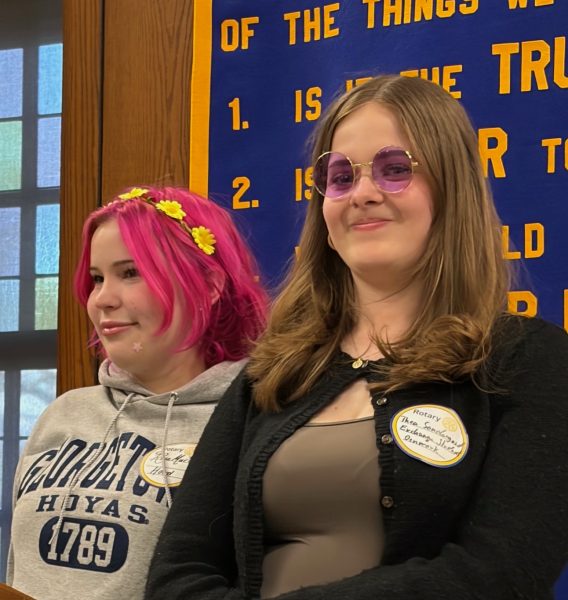
Peace Ambassadors: Marlena Studer, along with Rotary Student Exchange students Thea, and Rose announced an upcoming concert on April 11 from 7-9 p.m. titled “Love Letter to Mother Earth,” which will feature musical performances and sing-alongs, with attendees encouraged to wear 1960s-style clothing and bring recyclable items in exchange for free flower seeds.
Dean Neil Sukhatme, “Free Our Vote”:
Free Our Vote is a nonpartisan organization founded by Dean Sukhatme to restore voting rights for people with felony convictions, 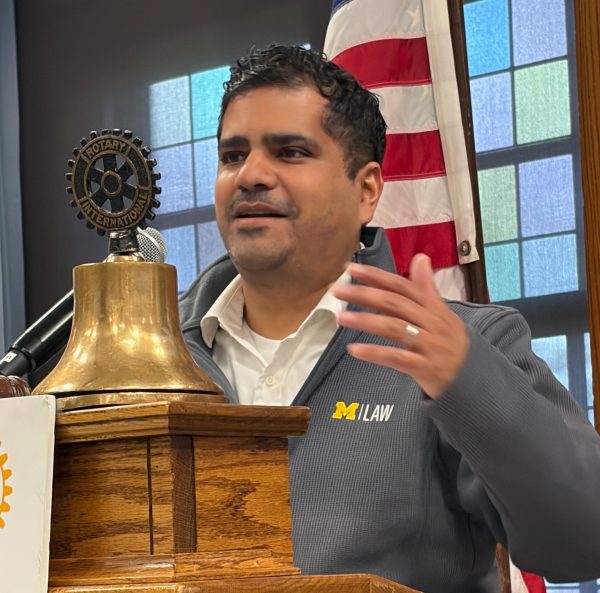 initially focusing on Florida’s felony disenfranchisement laws. He explained that these laws were enacted after the Civil War during Reconstruction and affect an estimated 1.7 million people in Florida. A 2018 ballot initiative allowed people to vote again after serving time, but the state legislature added a provision requiring payment of legal financial obligations before voting. However, felons were not told how much they owed. He detailed how he developed the Free Our Vote project to collect data on what individuals owed, and then to help identify individuals who didn’t know that had been cleared of debt (if any) and could vote. He discussed his work on voter re-enfranchisement, describing how his team connected half a million records and identified eligible voters in Florida. He explained their efforts to pay off small fines and fees owed by approximately 2,000 individuals, which resulted in a 16-26% increase in voter turnout among notified and helped individuals respectively. This program is now scaling to other states.
Dean Sukhatme presented additional research on judicial corruption in Texas, showing that attorneys who donate to judges receive more cases and better outcomes, including faster case resolution. He explained that the correlation exists even when donations occur after elections and that the impact is particularly harmful for defendants represented by these attorneys. When asked about solutions, he suggested several approaches including eliminating partisan elections for judges, prohibiting attorneys from donating to judges they practice in front of, or implementing public defender systems, though he acknowledged that implementing changes is challenging despite evidence of the problem.

