


Chat before our August 25, 2021 meeting included a geography lesson on the Northern Michigan islands and enthusiastic reviews of Summer of Love, a performance featuring several of our members at Burns Park the previous weekend. Kathy Waugh had the starring role and Heido Vitso’s ballerinas brought delight to the evening.
Executive Director Lori Walters closed the chatter at 12:30 and President Susan Froelich rang the bell to start the meeting. Tom Strode played The Star Spangled Banner and accepted birthday wishes.
Dawn Johnson gave us some statistics on our beautiful Great Lakes, reminding us of the important role they have in our state and the environmental threat they face. She urged us to value them.
Marlena Studer, accompanied by guitarist Steve Ragsdale, continued the water theme with a rendering of Bridge Over Troubled Waters.
President Susan regained the podium and thanked the people who made the meeting run smoothly. She announced birthdays.
She announced the sad news that Andy Dahlmann was in a serious bike accident. He is home now, and would enjoy receiving cards and notes.
There will be no meeting on September 15 as the Golf and Tennis Outing on Monday the 13th counts as a meeting.
Norma Sarkar talked about our need for more members. Our count was 243 at July 31. Since 60% of our dues go to Fixed Costs,

the more members we have, the more of the remaining 40% can be spent on our community projects. She urged us to look at colleagues, friends, neighbors as prospective members and to talk up Rotary. The nomination form is on our website under Membership Resources, or contact Devon Meier to get more help.
Charlie Koopmann announced that we still need golfers and diners for the Golf and Tennis Outing on September 13. He is excited about the after dinner speaker, Jack Harbaugh, promising an interesting, informative and entertaining talk.
Sal Barbatano is still looking for 6 – 8 more volunteers to work the day of the Outing. There will be a training session on September 12 at Fox Hills. Details on this training are yet to be determined. Volunteers will be required to wear khaki pants or skirts and white Rotary golf shirts, which are available for $28.00. Contact Sal with your shirt size if you need one: salbarbatano@gmail.com.
Kathy Waugh asked members for auction items. She is willing to pick them up. Contact her to donate or help with the auction setup.

Lauren Heinonen updated us on the Public Image Committee. She observed that public image is public engagement and shared some of the committee’s ideas for engagement. Among them are an event at the Rotary park, a talent show featuring members of the community, and recognition of 30 Under 30 – an event awarding recognition to outstanding young Ann Arborites.
Notes from the Program
Past President Joanne Pierson introduced our speaker, Drew Gronewold. He is Associate Professor of Ecosystem Science and Management studying Climate + Energy, and Water in the School for Environment and Sustainability. He has had a long string of academic appointments and continues to work with NOAA. His topic was “Water Abundance Across the Great Lakes”.
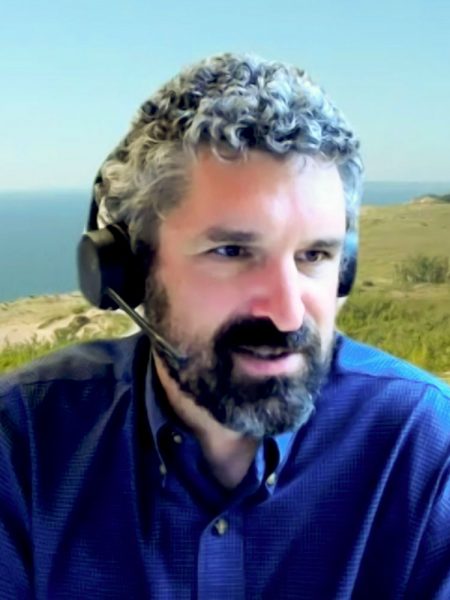
Professor Gronewold started his presentation recognizing and thanking his graduate students, who tracked down, assembled and interpreted the many data points he studies every day. He also thanked colleagues at NOAA who provided insight and helped refine his thinking.
From the 1990s until 2012, the water level in the Great Lakes as very low, but since 2013 levels have surged to record levels. This results in flooding and coastal erosion. Low ground water levels challenge state and municipal supplies; the city of Joliet, Illinois ran out of water and had to negotiate an agreement with the Great Lakes Compact, a collaboration of the governmental entities in the U.S and Canada that surround the Lakes, to divert water from Lake Michigan. High lake water levels bring a different and equally difficult set of challenges.
Professor Gronewold presented a soil moisture map of the United States, which shows the drought in the far and mid west, and the soaking of the south east. He also presented a chart of the ten largest lakes in the world, which showed that four of our lakes have 80% of lake surface area, but not a commensurate proportion of water volume.
Water comes from the interplay of seven major air masses continually moving and meeting over our land mass. Water levels are result of the balance of runoff, rain, and evaporation. In 2012 and 2013, Hurricane Sandy brought vast amounts of water into the Great Lakes. The polar vortices of the last years have cooled the upper atmosphere, which has reduced evaporation and as a result, water levels have greatly increased. Professor Gronewold showed bar graphs that traced water levels for the last 50 years, which imply that the high water levels will continue and increase.
Professor Gronewold did not venture into the area of policy. He recommended four books for further study, which are listed below. He emphasized that water quality is as important as water quantity.
There were many questions which Professor Gronewold graciously answered. First was the cause of the algal blooms, which are the result of agricultural and municipal runoff and rainfall.
Nestle was able to squirm under the restrictions of the Great Lakes Compact by altering the sizing of their bottles and the pumps. The impact of the pumping is local but still severe for Osceola County.
There is much people can do on an individual basis to conserve water. Professor Gronewold mentioned bathroom and kitchen plumbing fixtures, recycling water.
We don’t know the true scale of the PFAS contamination. It is not a social justice issue – we all drink water.
The impact of water on housing depends on the quantity and quality of available water. High water levels cause problems, not for just coastal residents.
It is not economically feasible to divert water the the American West right now. It is possible to recharge depleted aquifers.
Regarding Asian Carp expansion, the electric barriers separating the Chicago River from Lake Michigan appear to be holding right now, although DNA is showing up north of the barrier in birds and other creatures. Ironically, the zebra and quagga mussels that have caused such damage can help discourage the spread of carp. Carp are bottom feeders and the mussels filter the water so thoroughly that there is not sufficient biomass to sustain carp.
The Great Lakes Compact is a totally voluntary collaboration of municipalities with no enforcement authority – participants can leave at will.
The Gelman Plume is slow to spread and could be in such low concentrations when it reaches the Huron River that it is not harmful to humans.
When asked what blogs and websites to watch for ongoing information about the Great Lakes, Professor Gronewold suggested NOAA and the Great Lakes Environmental Laboratory.
With that last question answered, the meeting closed down.
President Susan had closed the meeting promptly at 1:30, with the following quote from Colin Powell: “Indeed, we’re strongest when the face of America isn’t only a solder carrying a gun but also a diplomat negotiating peace, a Peace Corps (or Rotary) volunteer bringing clean water to a village, or a relief worker stepping off a cargo plane as floodwaters rise.”
Books suggested by Professor Gronewold
Cadillac Desert by Marc Reisner
The Source: How Rivers in America are Made and remade, by Martin Doyle
Death and Life of the Great Lakes, by Dan Egan
Great Lakes Water, by Peter Annin
Notes by Agnes Reading; Photos by Fred Beutler

