


The January 27, 2021 meeting opened on Zoom with social time to start the meeting and members announced their attendance via the chat function in Zoom.
Lori Walters opened the meeting and said that there was some interference with the speaker last week and due to this issue, everyone will be muted upon entering the Zoom meeting. So please remain on mute (except during the social time) but especially during the speaker portion of the meeting.
At 12:30, President Joanne started the meeting. She asked Tom Strode to lead us in “America the Beautiful.” President Joanne rang the bell after the song. Rebecca Pazkowski provided the inspiration. For the musical interlude, “La Marseillaise” from the movie “Casablanca” was shown via YouTube.
President Joanne welcomed the attendees (103) and welcomed members & guests and thanked the set-up team, the photographer, reporter, and attendance taker. She announced the birthdays for the week.
The Distinguished Service Award was presented to deserving honoree Dave Keren by Greg Stejskal and Carol Senneff . Dave’s lifetime professional achievements were reviewed including his degrees earned at Illinois where he was an honor student, Phi Beta Kappa, received his Master’s degree in Immunology & Pathology along with his medical degree. He attended The Johns Hopkins medical residency program and then served as a Major at Walter Reed Army Institute for Research. Dave joined the U-M Pathology Dept in 1978 and then shifted to work at St. Joe’s. He was rehired by U-M as Clinics Director at UMHS. He is currently the CEO of a start-up involved in cancer research involving hereditary implications. Carol Senneff congratulated Dave on the award and shared activities Dave is involved in outside of his professional career especially his Rotary involvement. He served as a board member of Ozone House and joined Rotary in 2006 and has volunteered in many Rotary youth activities. He served for 4 years on the Social Committee, followed by service on STRIVE including Chair & serving as a mentor. Dave climbed Mt. Kilimanjaro about 10 years ago, has acted in about 20 local Ann Arbor Civic Theater productions, and is an active storyteller. Congratulations and well-deserved, Dave!
President Joanne announced that “Wine, Women & Song” is tomorrow night (1/28). CSA dues are (over)due. Please pay asap if your CSA dues are outstanding.
Dennis Powers introduced today’s speaker – Russ Collins, Executive Director of the Michigan Theater.
Russ presented a historical overview of “Arts & Entertainment in Ann Arbor”. He started the presentation by acknowledging that Covid-19 has been extremely damaging to the arts, so please support your favorite arts organization. In 2020, the Michigan Theater was behind by $2mm compared to the previous year, necessary cuts were made and generous support was received from donors. Russ estimates that Sept/Oct may be when performance spaces will be used meaning that 2021 will be another tough year.
Russ opened with a historical perspective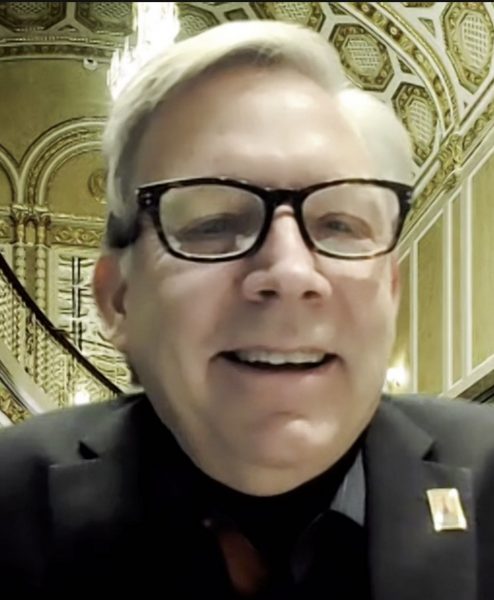 of the arts in Ann Arbor from 1824-1908. Ann Arbor was a frontier town from 1824 (founding) until the 1860’s. In 1854 the Detroit Observatory opened in a town where there were more bars than churches & the Observatory moved Ann Arbor into a scientific bent. In 1860’s – Hangsterfer’s building’s 3rd floor ballroom quickly became a gathering place. In 1871, Hill’s Opera House opened (later called the Whitney Theater) which hosted traveling shows, dramas, musicals, & vaudeville. The Whitney was also a hotel. Both were demolished in 1955. In 1873 – University Hall was built and was the first large auditorium constructed in the area. The organ in Hill Auditorium was originally installed in University Hall. Angell Hall was built in front of University Hall which was torn down in the 1950’s.
After the opera house era and after the Civil War, vaudeville was popular. Vaudeville is different from burlesque in that it is family entertainment. The Majestic Theater opened in 1909 in a building that had previously been a roller rink on Maynard Street. It closed in 1942 and in the 1960’s was demolished and replaced by the Maynard parking structure. The “Girl of the Golden West” (a Puccini opera) was the first play shown at the Majestic. Nickelodeon theaters were also popular during the 1910’s and were theaters in converted storefronts showing projected motion pictures. The Star Theatre was one such place, located on Washington Street where Arbor Brewing currently stands and where a famous riot occurred in 1908. Approximately 1,000-3,000 U-M students completed destroyed the theatre. Apparently, the Star Theatre manager was narrating a film (the common method of silent movie narration) & was heckled by a U-M student. The manager grabbed the student and threw him out. A couple of days later, students returned en masse and decimated the building including throwing a piano out of the 2nd floor window. This event received worldwide press coverage.
During the 1910’s & 1920’s was a time of grand theater construction including the opening of Hill Auditorium in 1913 designed by Albert Kahn. The Arcade Theater opened at 715 N. University in 1914 and destroyed by fire in 1928. The Rae Theater which opened in 1915 was located at 113 W. Huron Street. The Orpheum Theatre (where Gratzi is located) opened in 1913 and operated sporadically until 1957. The Weurth building at 322 W. Main Street was completed in 1917 and was a theater until 1957.
The Michigan Theater opened in 1928 and was built in 7 months – quite a feat! It opened as a vaudeville and movie theater and has had 4 different marquees. The successful effort to save the theater from being converted to a food court in 1979 was led by U-M Professor Henry Aldridge, Ann Arbor Mayor Lou Belcher & Philanthropist Margaret Towsley.
In 1827, the first African-American moved to Ann Arbor. Later, Ann Arbor was a significant stop on the Underground Railroad. Due to structural racism, African-Americans were excluded from attending traditional venues, so alternate arts & entertainment venues were used including churches, the Armory, and the Black Elks Club.
Other theaters to open included the Mendelssohn Theater in 1929 and Rackham Auditorium in 1938; The arts were used as a way to attract faculty to U-M. Rackham is mainly used for chamber music, but acoustically it’s not the best.
The State Theater opened in 1942 as cinema-style theater (no stage – so it could not host plays or concerts). It was designed by famous Detroit architect, Howard Crane who also designed the Fox Theater, Orchestra Hall, and United Artists Theater in LA. In 2013, the building was saved from becoming office space. In 2017, the State Theatre reopened as a 4-screen cinema.
Theaters to open in the 2nd half of the 20th century include: Campus Theatre (1957-87), Fifth Forum/Ann Arbor Theatre (1966-99), Wayside Theater (1968-1989) which had the biggest screen when it opened, Fox Village (1967-2005), Movies at Briarwood (1972-2012). Showcase Cinemas opened in 1988 and Quality 16 in 1999.
U-M has shown leadership in arts due to having a comprehensive strategy but the City of Ann Arbor & Washtenaw County have never had an arts strategy and no dynamic arts funding which has been a missed opportunity. Other missed opportunities for the community include Robert Frost’s potential permanent move to Ann Arbor which ended with the death of U-M President Burton who had promised the funds. Another missed opportunity involved the Power Center which was considered as a possible location for the Guthrie Theater when it was being planned in the 1960’s. Ann Arbor Film Festival has ad continues to have world-wide recognition. The Ann Arbor Blues & Jazz Festival ran from 1969-73 but the City of Ann Arbor provided no support and made it very difficult for festival operators. The ONCE Festival was a contemporary music festival in the 1960’s and the APA Phoenix Theatre Company also failed. There is no local government strategy and no financial support which flies in the face of our community’s values which emphasizes the quality of life. Most other progressive cities support their local arts organization financially through their local government
President Joanne announced that the Golf & Tennis Outing is scheduled for Sept 13, 2021.
President Joanne adjourned the meeting at 1:29.
Respectfully submitted by,
Jennifer Fike

