


Fourteen of the twenty tables seated bundled up Rotarians on January 30, the second coldest day in Ann Arbor in a generation. Don Devine rubbed it in with two songs, Let It Snow, Let It Snow, Let It Snow, and Winter Wonderland. Let it Snow was written in 1945 by Sammy Cohn and Jule Styne…in Hollywood! Winter Wonderland is not so rub-it-in – Dick Smith and Felix Bernard wrote it in NE Pennsylvania.
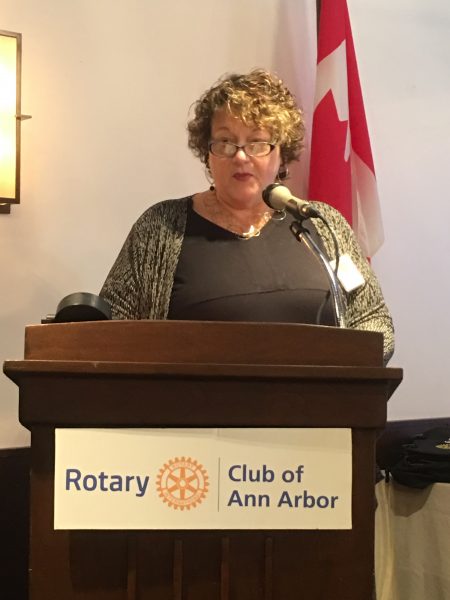 Kati Bauer’s Inspiration defined ‘inspiration’ for us, and challenged us with Gandhi’s words: “Be the change you wish to see in the world.” She gave some suggestions, finishing with another Gandhi quote, “Satisfaction lies in the effort, not in the attainment. Full effort is full victory”.
President Greg led off with thanks to the usual suspects, birthdays and guest introductions. There were only four announcements.
The Golf and Tennis Outing will be September 9, 2019 at Travis Country Club. The first planning meeting will be Tuesday, February 19, at 9:30 at Bank of Ann Arbor, Plymouth Road. Many hands are needed to stage our only fund raiser. Please give thought to pitching in – there are many jobs, some long, some short – and all are rewarding.
The Wine, Women and Song evening on January 24 was a great success. The house was full and everyone had a good time. If you missed it this year, make certain to come next year.
Greeters are needed to welcome Rotarians as we come into Weber’s. President Greg promised a barrel with a warming flame for the Greeter outside, who may find the yellow vest not really cozy. It is a great opportunity to visit with Rotarians one on one. Contact Barbara Eichmuller if you are wiling to come early to greet members and guests.
President Greg and First Lady Pat warded off chills in movie theaters. They recommend Stan and Ollie, a movies about the great comedians, and The Green Book. President Greg didn’t say whether they enjoyed the popcorn.
In the Question period following the Speaker’s presentation, Bev Sieford recommended The Library Book, by Susan Orlean. It is a history of the Los Angeles library and chronicles many of the changes our Speaker, James Hilton, talked about in his presentation.
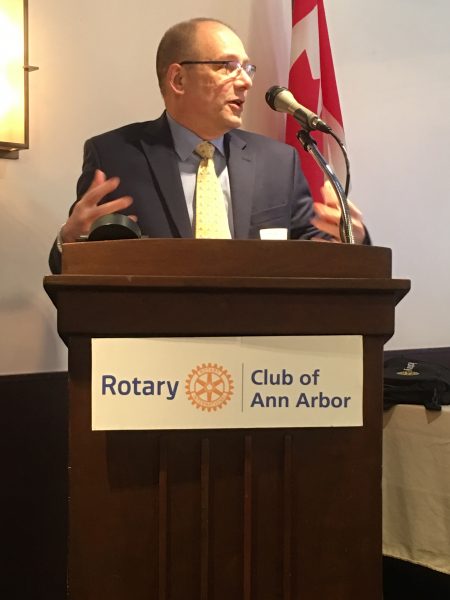
Notes from the Program
Kati Bauer introduced our speaker, Dr. James Hilton. Dr. Hilton was on the Michigan faculty
from 1985 until 2006 when he went to the University of Virginia. He returned to Michigan in
2013 and is now Vice Provost for Academic Innovation and University Librarian and Dean of
Libraries.
Dr. Hilton confessed this was his first time speaking to a Rotary Club and he was a little
apprehensive. He had heard Rotarians are crazy and that was confirmed in his opinion by the
number of people who turned out on such a cold day and with the decision to sing “Walking in a
Winter Wonderland” as a group. He said his own mechanisms for coping trend more toward
denial.
Dr. Hilton talked about the changing mission of libraries that face the public. They have become
gathering places for all ages and they have rhythms. A local library begins the day with small
children who come for story hour or just to play around; then come the seniors who use the
library as a sort of internet cafe; around 3:30pm youth show up to hang out with friends and do
some sporadic homework; then in the evening libraries present programs on a wide variety of
topics and host meetings of interest groups and citizens who come together to discuss local
issues. Local libraries have become social service centers where people can get information on
things from tax questions to referrals to service agencies.
University libraries also have a rhythm. They serve the needs of the university community and
are almost always located in the center of campus. Their mission is to support learning and
intellectual exploration for the university community, whether on campus or in remote locations.
In addition to written and electronic materials, three University of Michigan libraries – Hatcher,
Shapiro and Duderstadt Center – have collaboration space, production and rehearsal spaces,
maker spaces outfitted with such things as 3D printers and modeling equipment, and a
virtual/augmented reality studio. Because the libraries are open 24 hours, the long-standing rule
of no food or drink in libraries has been replaced with cafes. These changes reflect the new ways
that universities teach and students learn in the 21st century.
Michigan libraries have four million visitors a year. Last year they circulated one million books,
five million e-books, and nine million articles. They were first to join the Google library
material scanning project and now half of their collection is scanned.
An unseen but critically important thing major university libraries do is curating and preserving
the cultural and scholarly record. Making the history of research in a project or policy available
is important to understanding current thinking and prospects for the future. University libraries
also have become publishers, often to avoid the costs of re-purchasing research from the
dominant journals. While the majority of the collections are open to the public, they are
physically located in a variety of storage facilities and are delivered directly to patrons. The library is hoping to build a large, secure, climate controlled facility, replete with reading rooms and parking, to house the collection
In addition to the library collections, the University has created more than 100 MOOCS (Massive Open Online courses) that are freely available to the public at www.online.umich.edu.

