


President Dawn rang the bell at 12:30 pm. The meeting began by singing “God Bless America” with Rick Ingram on piano. After reciting the Four Way Test, Greg Stejskal inspired us with the background story of the Statue of Liberty and shared an excerpt from the poem by Emma Lazuras about what the Statue of Liberty means to our country. Click here to read Greg’s entire inspiration. Downs Herold then brought a little sunshine into our snowy day by leading us in singing “Smile, Sing a Song”. Next, there were seven birthdays to celebrate and both Dave McDowell and Fritz Seyferth are celebrating their 40th Anniversaries as Rotarians.
Announcements included: there are still seats available for the annual Rotary night of “Wine, Women and Song” on Thursday, January 29 at 7:30. Click here or Contact Shelley MacMillan if you want to purchase tickets. The GPO fundraising Dumpling Making party is scheduled for Saturday, February 7 and there are still some spots available. Contact Rosemarie Rowney to sign up. Highlights from the Board meeting are; Leo Shedden gave an overview of Corporate Membership which has been proposed by the Membership Committee. More information will be presented at next week’s meeting. Also discussed was our approach for policy review. Many of the policies will go to the appropriate committees for review and others will be discussed as a group. On February 25 there will be a meeting to go over strategic planning and a workshop for policies that require further discussion.
Police Chief and fellow Rotarian, Andre Anderson, introduced Mayor Christopher Taylor. Mayor Taylor has served as the Mayor of Ann Arbor since 2014. He has earned four degrees from the University of Michigan and is currently an attorney with Hooper Hathaway in downtown Ann Arbor. He has instituted several initiatives as mayor. Among them, A2ZERO a comprehensive plan to achieve carbon neutrality by 2030, and he has championed the development of over 1,000 units of permanent, affordable housing.
Mayor Taylor came to the podium and began by saying the best conversations are those that are back and forth. He continued by sharing that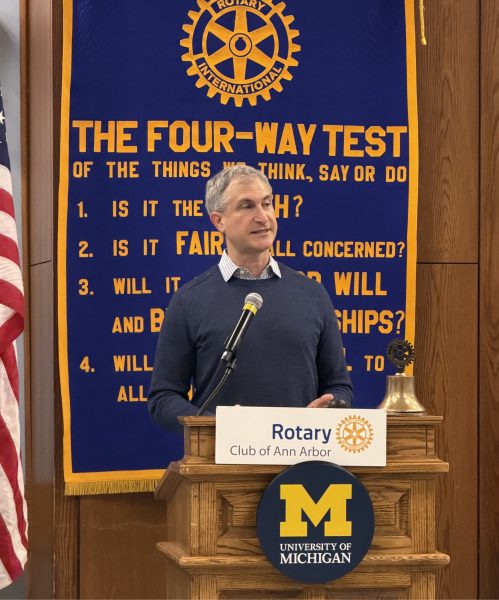 the City of Ann Arbor is in excellent financial health. It’s bond rating is AAA and the retiree pension, which was at 100% before the Great Recession, is now back up to being 90% funded. Retiree healthcare is now funded at 99.8%.
Next, he invited questions from the audience.
Q: What are your thoughts about police living in the city, possibly the city, providing affordable housing for the police and city employees in general?
A: Ann Arbor has a high demand for housing and housing supply has been kept low because of restrictive zoning. Since the Great Recession, housing prices have increased 4 times the rate of inflation and rents have increased 2.5 times. The city does not have the means to provide staff housing. What it hopes to do is pay staff as well as possible and ensure there is expanded housing supply at all levels and all income levels. It is looking to do this through zoning reforms and decreasing bureaucracy in the city.
Q: Does the City Council or Planning Commission ever look at what is the absorption rate of what’s going on?
A: The city does not play a role in controlling the impact of how the supply and demand of the market impact the community. It is aware of the social harm that is being observed and is trying to counter that through increased supply. At some point, someone is going to build something that misses the market and is too expensive. They will lose money. That’s the capitalist system we live in.
Q: What can be done about the taxable properties that the University of Michigan hold that are not taxed?
A: The University of Michigan was created by the state constitution and as a matter of constitutional hierarchy superior to the city. It can purchase property where they want or take it through eminent domain. That’s the nature of the relationship between the city and the university. Fortunately, the relationship is quite good even in the context of the power differential.
Q: Considering the problems in Minnesota, threats have been made that the president could target cities that claim to be a sanctuary city? What is your assessment of this risk?
A: Ann Arbor is not a sanctuary city because sanctuary cities do not exist. The federal government Supremacy Clause prevents the obstruction of the federal law enforcement in local municipality. In 2017, the City of Ann Arbor passed a resolution with respect to immigration enforcement that recognizes and honors the Supremacy Clause. We understand that federal exists, but we have our own authority and within the Freedom to Act we are choosing not to cooperate with federal civil immigration enforcement. We are also choosing not to sign cooperation agreements with federal law enforcement with respect to civil immigration enforcement and are declining requests administratively to retain people for civil immigration.
Q: MLive recently chronicled all of the projects under construction. Rumor has it that our water sewage system cannot handle the increased usage, is this true?
A: No building gets approved unless everybody in that building can drink or use as much water as the pipes to that building will allow. The bottom line is that water infrastructure in and out is always a necessary condition for approval.
Q: It seems like parking capacity is decreasing. What can be done for the elderly and disabled to allow them to come to downtown?
A: Currently downtown parking structures are underutilized. The DDA has increased the number of accessible parking spaces so citizens who have tags will have more places to park throughout the city. Everyone loves a parking spot right in front of their destination, there will be some street-level parking, but there will also be parking in structures. As people become more comfortable doing that, then that will be their experience.
President Dawn thanked Mayor Taylor for his insights and rang the bell ending the meeting.

