


Contributed by Collyer Smith.
O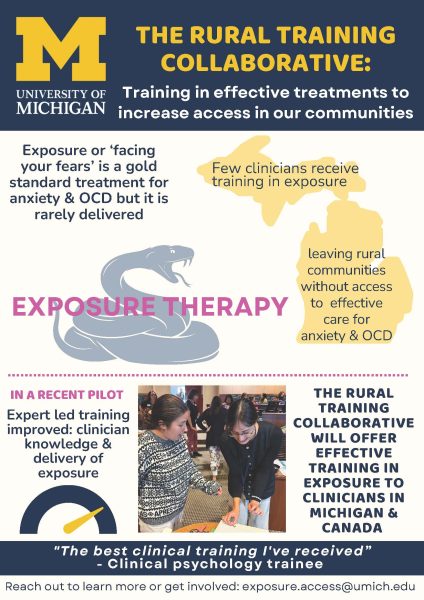 n Wednesday, January 7, 2026, I shared our upcoming collaboration with the University of Michigan Depression Center. The struggles in mental health are not diminishing, if anything, they are increasing. My visit with the West Bloomfield Rotary Club certainly highlighted what so many families are experiencing. It is not just the one person who is affected, but the entire family and close friends.
We plan to achieve $500,000 in funding in three years-for our collaboration with U of M Depression Center. We can make a huge impact in mental health. And as mentioned, Sam and I (mostly Sam) have already had firm commitments of over $110,000. So, we are on our way!
Our international partner for the Global Grant is the Rotary Club of Chatham – Chatham/Kent, Ontario, Canada. For close to10 years, I have worked with our Canadian Clubs on mental health initiatives. Our Rotary International Representative, Cecelia Walter, and I have had numerous conversations regarding the Global Grant. She shared with me how prepared and organized our plan is- and gave me the Green Light.
Here are our notes from my conversation with our lead at the U of M Depression Center-
After our conversation, I think we agree that the proposal should focus on establishing an infrastructure to deliver evidence-based mental health training to community providers. While OCD in youth would be the initial training, the proposal should broadly highlight the training model and infrastructure itself, and how building this capacity will address the critical provider shortage and improve outcomes for both providers and patients. Attached is the description I sent prior to the holiday.
General:
We’re building a statewide training network to tackle one of the biggest challenges in youth mental health: limited access to effective treatment. The U-M Eisenberg Family Depression Center will establish a sustainable infrastructure to train and support local providers in practical, evidence-based tools so they can deliver high-quality mental health care right where kids live. By strengthening the local workforce, we reduce provider shortages, improve care quality, and help more young people recover and thrive.
Rotary-specific:
Rotary helped change the world by building the infrastructure to end polio – trained people, trusted partnerships, and systems that could reach every community. When Ebola emerged, that same infrastructure made it possible to respond quickly and effectively. We’re taking that same approach to the youth mental health crisis. We’re building an expansive training network that equips local providers with proven training and tools to effectively treat youth mental health. Evidence-based mental health treatment will reach places it has never gone before. It will start with one urgent need – Obsessive Compulsive Disorder – and expand over time to other illnesses, creating a sustainable system that strengthens communities and heals young people.
Railway analogy:
We’ll build the statewide infrastructure – the ‘train tracks’- connecting rural communities to specialty mental health training. Then we bring in expert faculty to run different ‘trains’ (OCD, suicide prevention, depression, eating disorders) over that same network. Each train runs on the same track network, reaching communities that otherwise have no access to these specialty resources. Because the infrastructure is shared, every new specialty becomes easier and more efficient to deliver. The result is a scalable, renewable system that grows the rural workforce in evidence-based youth mental health care.
If you are interested in learning more about our work, or would like to be involved- please let me know at: collyerasmith@yahoo.com

